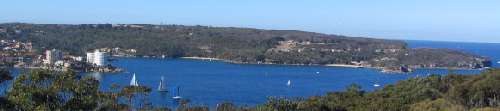
Car-rang-gel was and is a very significant place for Aboriginal people.
North Head was a place where traditional physical and spiritual healing took place for Aboriginal
communities up and down the east coast of Australia.
It was a place for men and women of high degree to meet and conduct ceremonies.
In acknowledgement of this significance, North Head Sanctuary Foundation have established a display
board of information about Aboriginal heritage in Building 20 and, in consultation with Aboriginal
elders have created a brochure and poster about the ways in which Aboriginal people used the plants
found in the vicinity of North Head.
Click here to see the brochure about Aboriginal Use of Plants
(4718kb pdf file)
In the early days of North Head Sanctuary Foundation, our members consulted with Aboriginal people
and drew up a vision statement (see below). The vision has not been fully realised yet but we have,
from time to time, been privileged to have Aboriginal speakers at meetings and Aboriginal discovery
walks led by people like Aunty Fran Bodkin.
Aboriginal Heritage Vision
prepared by the Aboriginal Heritage working group of NHSF
Vision
North Head was a place where traditional physical and spiritual healing took place for Aboriginal
communities up and down the east coast of Australia. It was a place for men and women of high degree
to meet and conduct ceremonies. The vision is to create a Place where Aboriginal and non-Aboriginal
people can appreciate and celebrate our rich Aboriginal heritage, connect with the land and learn about
the oldest surviving culture in the world.
Mission
To establish an Aboriginal Education Centre which raises awareness and celebrates the Aboriginal
culture and heritage of the area. The Centre is a place of learning which affords visitors the
opportunity to understand the significance of Aboriginal heritage and its place within the shared
history of Aboriginal and non-Aboriginal people since 1788.
Objectives
- Include an Aboriginal Education Centre within Sydney Harbour Federation Trust plans for North Head.
- Consult with the appropriate Aboriginal organisations in the creation of such a Centre.
- Investigate the educational programs and cultural experiences, which will be incorporated into
the Centre. e.g. bush tucker tours; dance and cultural performances; art and craft exhibitions.
- Investigate and identify existing research and reports on the Aboriginal heritage of the North Head site.
- Use Aboriginal expertise to identify the nature of cultural sites and provide advice on general
public access to particular areas as distinct from sites of a secret sacred nature.
- Seek expert advice from Aboriginal and non Aboriginal people on the best methods of preservation
of heritage sites.
- Discuss and identify, through consultation with the appropriate Aboriginal bodies and the Sydney
Harbour Federation Trust, the best site for location of the Centre.
- Ensure that Aboriginal people are the driving force behind the development of plans for the site
and in its management.
- Maximise the opportunities for employment of Aboriginal people in the planning, construction and
operation of the Centre.
- Identify major funding opportunities/bodies for the Centre.
- Honour Carol Kendall's vision by including a place of healing.
This Aboriginal Heritage Vision was prepared in 2002/2003
by the Aboriginal Heritage working group
of the North Head Sanctuary Foundation
Statements concerning the Aboriginal Significance of North Head
North Head was part of the setting for some of the earliest interactions between Aboriginal people
and early European settlers and explorers. Such interaction included the capture of Bennelong at
Collins Beach in 1789. It is at North Head and in nearby Manly Cove that the first fleeters and other
early settlers gained their first impressions of Aboriginal people. It has been said by one Aboriginal
archaeologist that "The Aboriginal association of North Head extends past the historical, based on
relationships of people, place and event, and is of such significance that the statewide NPWS criteria
is not adequate to judge it by".
The early dedication of North Head by the New South Wales and Commonwealth governments for quarantine
and military uses, and the establishment of park reserves, has resulted in the survival of many of the
headland's geological features, flora and fauna in a landscape with rich cultural associations, both
Indigenous and more recent.
Archaeological studies demonstrate the existence of more than 40 sites and places of Aboriginal
heritage and occupation distributed across North Head, but it is acknowledged that more are likely to
be hidden by the very dense vegetation across parts of the headland. Extensive shelters and middens,
burial sites, rock engraving and art sites and other places of significance are present, indicating
significant Aboriginal habitation of the area. Open campsites of the type identified on North Head
"are now rare in the urbanized Sydney region".
More recent research indicates a greater Aboriginal presence on North Head, demonstrating that it
was a place for special gatherings of the Guringai peoples, and also that North Head was an important
place to the koradgee men responsible for both burials and healings - a place of Aboriginal spirituality
and significance.
Extracts from the 2004 application for nomination
for Commonwealth Heritage Listing for North Head